
September 28, 2026
Six students in the Department of Immunology have been awarded highly competitive National Institutes of Health (NIH) Ruth L. Kirschstein Predoctoral Individual National Research Service Awards, also known as F30/F31 fellowships. These competitive awards, which recognize promising early-career researchers, will support dissertation research on topics ranging from T cell exhaustion in cancer and the influence of gut microbes on cancer immunotherapy to understanding inflammatory disease and building computational tools to predict gene expression.
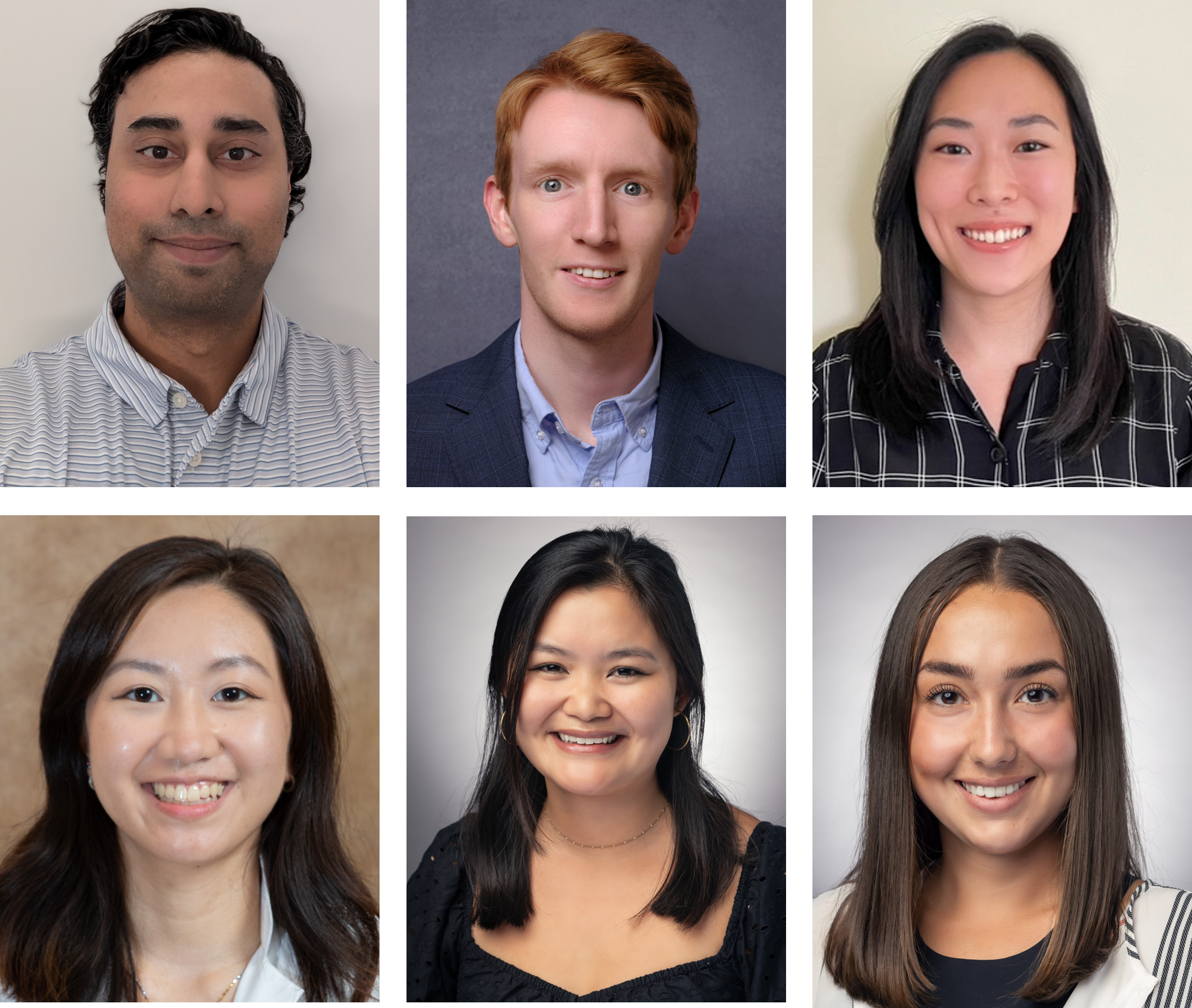
From left to right: Kieran Adam, Samuel Butler, Amanda Lee, Danica Lee, Jane Siwek, and Anamarie Martinez-Turak
Kieran Adam
National Institute of Allergy and Infectious Diseases (NIAID) F31 Fellowship
“Characterizing LAG3 Binding to the TCR/CD3 Complex and LAG3 Ligands that Modulate Immune Response”
Kieran Adam, a Program in Microbiology and Immunology (PMI) graduate student in Dario Vignali’s lab, is studying LAG3, an inhibitory receptor that suppresses T cell activity and is already a target of cancer immunotherapy drugs. With this fellowship, Adam will investigate different molecules that that bind to LAG3 to modulate its inhibitory function and assess which of these molecules are essential for LAG3 function in mouse tumor models. Ultimately, this research will provide key insights about LAG3 function that could enhance immunotherapies or lead to novel treatments for inflammation and autoimmunity.
Samuel Butler
National Cancer Institute (NCI) F31 Fellowship
“Determining the Role of TOX in the Maintenance of CD8+ T Cell Exhaustion and Memory Development”
A PMI graduate student advised by Dario Vignali, Sam Butler focuses on TOX, a master transcription factor that regulates T cell exhaustion in tumors and viral infections. To learn more about the role of this transcription factor in exhausted CD8 “killer” T cells, Butler will generate mice lacking TOX in progenitor and terminally exhausted cells and determine the implications on cell survival, functionality, anti-tumor immune response, and T cell memory development. This work will shed light on how T cells are maintained in an exhausted state and potentially inform novel TOX-targeting immunotherapies.
Amanda Lee
NCI F31 Fellowship
“Harnessing the Microbiota Metabolite Indoleacrylic Acid to Improve CD8+ T Cell-Based Cancer Therapies”
Amanda Lee is a PMI graduate student in Marlies Meisel’s lab whose research focuses on how gut microbial metabolites influence the effectiveness of cancer immunotherapy. She will investigate a novel antitumor role for the microbial metabolite indoleacrylic acid (IA) and the mechanisms IA employs to directly enhance CD8 T cell antitumor immunity. Her research aims to uncover actionable microbial metabolite pathways that can be leveraged to improve cancer immunotherapy response and establish IA as a potential adjuvant for cellular therapies in solid tumors.
Danica Lee
NIAID F30 Fellowship
“Regulation of type I interferon signaling by A20 (TNFAIP3) in autoimmune and autoinflammatory disease”
Danica Lee, an MD/PhD student in the Medical Scientist Training Program advised by Daniella Schwartz, studies a systemic autoinflammatory disease called Haploinsufficiency of A20 (HA20), which is caused by mutations in the TNFAIP3 gene. Building on the finding that HA20 patients have overactive type I interferon (antiviral) responses, she will investigate which immune cells drive this dysregulation in both patient samples and mouse models. This research could help explain why some patients do not respond to current treatments and guide the development of new targeted therapies.
Jane Siwek
National Heart, Lung, and Blood Institute: F31 Fellowship
“Identification of immune microniches and therapeutic targets in HFpEF using interpretable machine learning and interaction language models”
Jane Siwek, a CPCB student advised by Jishnu Das and Niranjana Natarajan, is studying heart failure with preserved ejection fraction (HFpEF), a complex condition, driven in part by systemic inflammation and cardiac fibrosis, that lacks effective treatments. Siwek will combine spatial omics, immunoreceptor profiling, and machine learning to characterize how innate and adaptive immune cells are spatially organized and interact within the heart to drive disease progression. She will also develop a new machine learning tool called DrugSWING to predict drugs with potential for repurposing for use in HFpEF.
Anamarie Martinez-Turak
NIAID F31 Fellowship
“Linking Signaling to Gene Expression with Mechanistic Modeling and Machine Learning”
Anamarie Martinez-Turak, a graduate student in the Joint CMU-Pitt Ph.D. Program in Computational Biology (CPCB) advised by Rachel Gottschalk, will investigate how immune cells translate signals from their environment into distinct gene expression responses. Martinez-Turak will develop a computational model that integrates cell signaling with DNA sequence to predict gene expression. This research could ultimately help inform the development of more targeted therapies that shape immune function.