
November 3, 2026 | By Asher Jones
As an undergraduate in the Microbiology and Immunology Departments Scholars (MIDS) program, Noor E. Nader was deeply frustrated by an experiment that kept failing, despite her best efforts. But her advisor, Tullia Bruno, assistant professor of immunology, reassured her, explaining that it’s normal for experiments to fail and that learning from failure is an important part of the scientific process.
“Her words have stayed with me ever since,” said Nader, now an MD-PhD student at the University of Pittsburgh in Bruno’s lab. “They felt especially meaningful when, after three years of persistent work and numerous setbacks, I recently learned that my first-author manuscript had been accepted for publication in our first-choice journal. This achievement reminded me that failure is not the end in science but an essential part of the journey.”
MIDS, a joint initiative between the Department of Immunology and the Department of Microbiology and Molecular Genetics at Pitt, gives students like Nader their very first hands-on research experience in an immunology or microbiology lab, equipping them with practical research skills and shining a light on research careers.

Tullia Bruno and Noor Nader. CREDIT: Asher Jones
“Throughout the program, students really grow as researchers and gain a clear vision of what a career in science looks like and the steps needed to get there,” said Amanda Poholek, associate professor of immunology who recently finished her term as MIDS director. “It’s really rewarding to see them get the research ‘bug,’ coming to lab more and more engaged in the science.”
Taking over from Poholek as MIDS director is Kevin McCarthy, assistant professor of microbiology and molecular genetics in the Center for Vaccine Research. Daniella Schwartz, assistant professor of medicine and immunology, is the new deputy director of the program, who will step up to the director role after McCarthy.
“The goal of MIDS is to provide the support and mentorship required for undergraduate students to thrive during their first research experiences,” said McCarthy. “Unlike many professions there is no singular pathway to research science. Landing a first research position is stochastic, often very difficult and at the same time transformative for one’s career. MIDS simplifies this process for our scholars and provides additional mentorship and training from our PMI graduate students.”
The Birth of MIDS
MIDS was started by PMI (Program in Microbiology and Immunology) graduate students during the COVID lockdowns of 2020 after they realized that there weren’t many opportunities for undergraduate students to get hands-on research experience.
“We realized that without these [kinds of] programs, we wouldn’t be here at Pitt, and Pitt didn’t have a program that other schools we went to for our undergraduate degrees had,” said Ayana Ruffin, now a postdoc at Emory University who helped launch MIDS as a PMI graduate student. “We talked to faculty and department chairs about our program idea (at Pitt) and they backed us on this.”
MIDS is open to rising sophomores or juniors from Pitt, Carnegie-Mellon University, and Chatham University who have not yet had an opportunity for research. Scholars must commit to 10 hours per week over four semesters.
“I worked with a student who grew up in a rural community with parents who felt strongly that higher education was a waste of time. Even though they were relatively affluent, they refused to pay for college,” said Schwartz. “She had to work her way through college, and her grades suffered for it. She wanted to do science more than anything, but she kept getting screened out of opportunities because her CV didn’t show how hard she’d worked. MIDS exists for exactly that kind of student: the ones who have the fire but can’t get their foot in the door.”
A Lasting Impact
Since launching in 2020, the program has graduated 22 scholars, almost all of whom are still in science, many pursuing PhD or MD-PhD degrees at programs across the country.
One of those alumni is Chetachukwu Obiwuma, now a third-year MD-PhD student at the Texas A&M University Naresh K. Vashisht College of Medicine. Before the program, Obiwuma had zero research experience. Mentored by Daria Van Tyne, associate professor of medicine, she worked on characterizing a gene that contributes to the virulence of a hospital-associated pathogenic bacterium called Enterococcus faecalis.
“The MIDS program was heavily significant in getting me to where I am today,” said Obiwuma. “It's what introduced me to MD-PhD programs in the first place, and my time in the program—and staying in Dr. Van Tyne’s lab to complete a senior thesis afterwards— demonstrated my commitment to research, which greatly strengthened my applications for MD-PhD programs.”
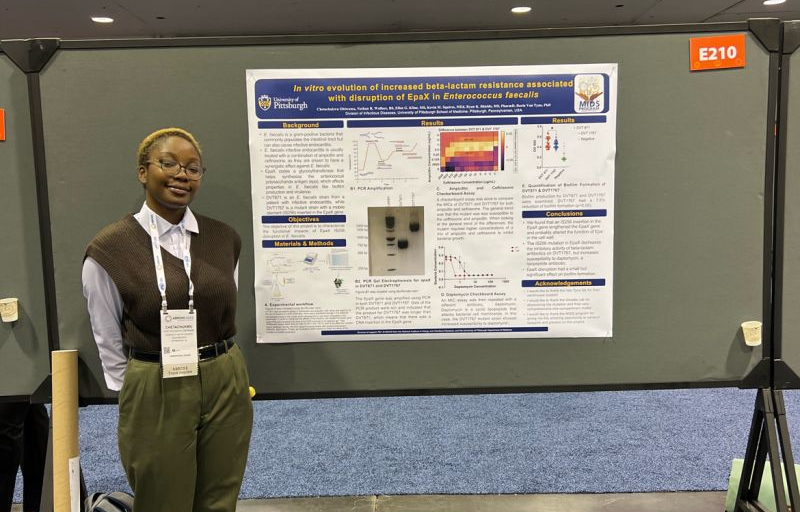
MIDS alumna Chetachukwu Obiwuma presenting her research at Annual Biomedical Research Conference for Minoritized Scientists (ABRCMS). CREDIT: Image courtesy of Daria Van Tyne.
Scholar Support
Scholars are mentored by a faculty advisor and work closely with technicians or graduate students in their lab. They are also paired with a PMI graduate student who is not in their faculty advisor’s lab: a near-peer mentor.
“Near-peer mentors are an important part of the program,” said Poholek. “It’s an extra layer of support for the scholars: someone outside of their own lab who they can go to with any question, who checks in and makes sure they’re making progress.”
Graduate students and postdocs also play key leadership roles in MIDS. As co-leads of education, Daria Jelic, PMI graduate student in Doug Reed’s lab, and Nicole Ponde, postdoctoral scholar in Sarah Gaffen’s lab, are responsible for organizing the educational framework of science and professional development seminars that run through the fall and spring semesters. They also assist with interviews for incoming MID scholars and provide input to faculty leadership on future changes to the structure of the program.
“It’s incredibly rewarding to see students come out their shells over the two years that they participate in the MIDS program,” said Jelic. “The MID scholars have formed a community onto themselves as well. I have noticed that scholars in their second year of the program are really devoted to helping those who are newer to the program, and that reciprocity has been really beautiful to watch develop.”
Participating in MIDS benefits graduate students and postdocs, too.
“Being involved in MIDS has helped me grow as a mentor and taught me a lot about what it takes to run a program like this,” said Ponde. “My long-term goal is to become a PI, and an important part of that for me is encouraging the next generation of scientists to pursue research. If I had the chance to, I would love to establish a similar program that supports students who may not otherwise have access to these opportunities.”
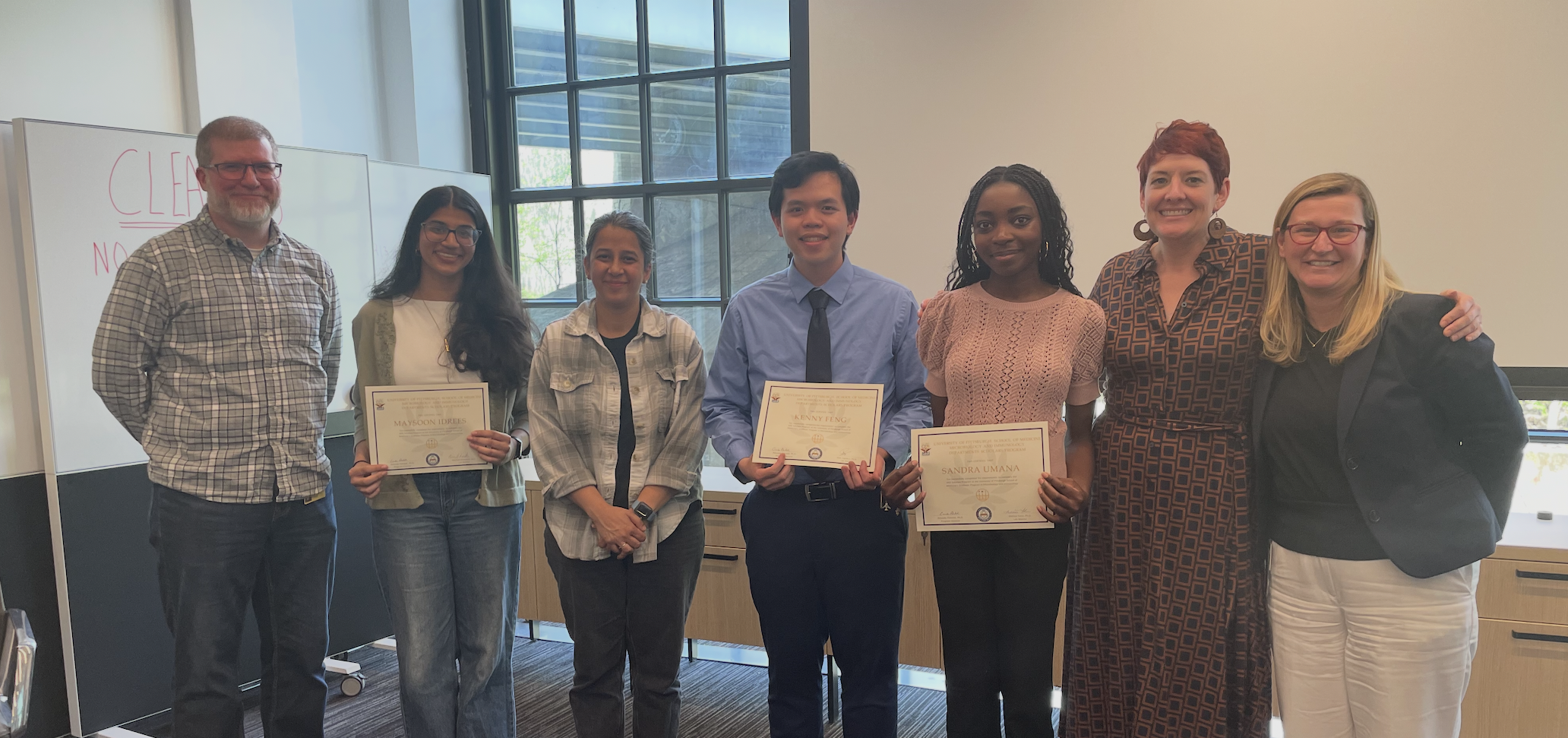
Celebrating 2026 MIDS graduates. From left to right: Brian Firek, lab manager in Michael Morowitz’s lab; Maysoon Idrees, MID scholar; Sanya Arshad, postdoc in Alok Joglekar’s lab; Kenny Feng, MID scholar; Sandra Umana, MID scholar; Melissa Kane, assistant professor of pediatrics and immunology; and Amanda Poholek, associate professor of immunology and former director of MIDS.
Building Connections
As part of the program, MID scholars are paid a travel stipend to encourage them to present their research at local and national conferences.
“One of my most memorable experiences through the MIDS program was being able to attend ABRCMS to present my research as a poster,” said Obiwuma. “This experience was very significant to me as it was my first time going to a national conference and I got to meet many likeminded people who I am still in contact with today.”
Those connections are almost as important as the practical research experience MIDS provides, according to Nader.
“Working alongside graduate students, medical students, postdoctoral fellows, research technicians, and PIs introduced me to the many roles involved in scientific research,” she said. “I built a strong professional and personal network of mentors and colleagues who reviewed my medical school applications, wrote letters of recommendation, helped me strengthen my presentation skills, became research collaborators, and, in some cases, became lifelong friends.”
If you would like to support the MIDS program, you can do so here.