
July 22, 2026 | By Asher Jones
A novel network-based framework that captures complex webs of gene regulation and protein interactions has resolved a longstanding debate about maturation of T follicular helper cells (Tfh)—a subset of T helper cells that guide the production of high-quality, long-lasting antibodies after infection or vaccination.
The new findings and framework, termed CoreNet, is published today in Nature Communications by co-senior authors Jishnu Das, associate professor of immunology, Rebecca Elsner, assistant professor of immunology, and Vinay S. Mahajan, assistant professor in the Department of Medicine at Brigham and Women’s Hospital, and first-author Alisa Omelchenko, member of Das’s lab who is a graduate student in the Joint CMU-Pitt PhD Program in Computational Biology (CPCB), and their team. Contributors from Das’s lab include former postdoc Syed Rahman, CPCB graduate students Alyson Wang, Tracy Tabib and Swapnil Keshari, and Integrated Systems Biology (ISB) graduate student Yijia Chen. Amanda Poholek, associate professor of immunology, and Mark Shlomchik, distinguished professor of immunology, were also key collaborators.
“Using an unbiased systems approach, we found that there is a core network that underlies Tfh differentiation in both mice and humans,” said Omelchenko. “It’s not as different between species, as other researchers had reported, it’s just that people had found different parts of the network.”

Jishnu Das, associate professor of immunology, Rebecca Elsner, assistant professor of immunology, and Alisa Omelchenko, graduate student in Das's lab.
The findings shed light on how Tfh cells could be targeted to optimize vaccine strategies, provide validation that mice are a good system for understanding these processes in humans, and offer proof-of-concept that the CoreNet framework could be applied to other complex questions in immunology and beyond.
During infection or after vaccination, activated B cells follow one of two pathways. The extrafollicular response produces a rapid burst of short-lived B cells that produce antibodies for immediate defense while the germinal center (GC) response results in long-lived memory B cells that produce high-quality antibodies that confer lasting protection. Tfh cells help orchestrate development of GCs in the lymph nodes, tonsils, and spleen.
Understanding which genes and signals regulate the differentiation of naïve helper T cells into Tfh cells had caused a “kerfuffle” among immunologists, according to Das.
“Tfh differentiation is a long-standing question that has intrigued the field,” he said. “A lot of people have brought different tools to the question and found different answers.”
The reason, say Das and Elsner, is that different researchers had looked at different “slices” of the data: different species, types of data, or disease states. As a result, studies had suggested that the cytokine IL-12 promotes Tfh differentiation in humans but inhibits it in mice, leading to the conclusion that mice and human Tfh differentiation is fundamentally different.
By visualizing the “full pie" of Tfh differentiation, the CoreNet framework resolved this discrepancy. The analysis of human data suggested that IL-12 was blocking the last stage of Tfh differentiation, which enables them to help GC B cells. When the researchers examined this hypothesis experimentally in a mouse model, their findings agreed: IL-12 specifically blocks progression to the fully mature GC Tfh state.
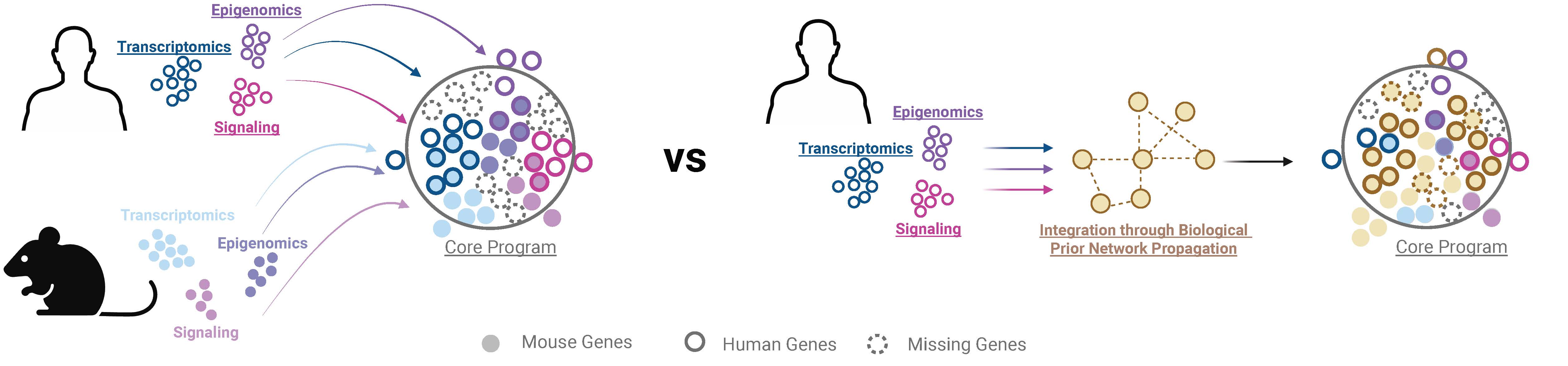
Individual analyses of transcriptomic, epigenomic, and signaling datasets capture fragmented “slices” of immune responses (left), whereas network-based approaches can integrate these views to identify a core program underlying immune responses such as CoreNet (right). CREDIT: Omelchenko et. al., 2026, Nat Commun.
These findings have important implications for using IL-12 as a vaccine adjuvant, according to Elsner. For example, in the rabies vaccine where rapid antibody production is required, the extrafollicular response could be optimized by including IL-12 to inhibit Tfh differentiation. For diseases such as HIV where the goal of vaccines is to produce broadly neutralizing antibodies via the GC response, IL-12 should likely be suppressed to promote Tfh differentiation.
The researchers started by separating the four different stages of Tfh cells from adult human tonsil samples. Next, they used an algorithm to analyze gene expression and epigenetic data (chemical modifications to DNA that turn genes on and off) not in isolation, but in the context of the underlying molecular networks. This helped them identify CoreNet: very specific modules (subnetworks involving certain genes) of the gene regulatory and protein-protein interaction networks that control Tfh differentiation.
While traditional analyses of gene expression data simply return lists of genes that are differentially upregulated, CoreNet identifies genes that sit at the most important control positions. Even if certain genes have a weak signal, the modules capture underlying network connectivity structure. The approach also captures components that are important both when they’re turned on and off.
For example, the analysis highlighted a protein called Blimp1 as an important regulator of Tfh differentiation.
“At first we thought that this didn’t make sense because Blimp1 is an inhibitor of Tfh cells,” said Elsner. “But a gene is either not on because it’s not important or it’s not on because it’s important, but it must be off. Using traditional methods, we wouldn’t have identified Blimp1, but CoreNet is powerful because it can identify important regulators even if they’re not expressed in the cell. That was really exciting to see.”
Das and Elsner are already planning to use the CoreNet approach to examine extrafollicular B cells, and they say that the method could be applied to understand the regulation of other immune and non-immune cells. They have also made the Tfh CoreNet data freely available as a public resource.
“This project reflects the systems and mechanistic strengths of our department coming together,” said Das. “Becky and I come from very different backgrounds and training, yet we came together to work on a problem of mutual interest. And I think that the result is greater than the sum of its parts.”